With my bike loaded for a backpack trip I set off from home to cycle
to Chorley to catch the 6:52 train to Manchester Piccadilly. It was
earlier than I needed to catch but being the start of the rush hour
I wanted to make sure I could get my bike on the train. I needn't
have worried as there was room and I reached Manchester Piccadilly
railway station on time. However because I caught an earlier train I
had well over an hour to wait for my next train which is the 09:07
service to Bristol Temple Meads.
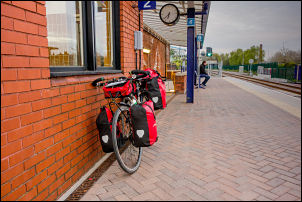
Chorley Railway Station
One of the annoying things about Piccadilly is there is no heated
waiting room and I had to sit in the cold, even though I was inside.
The train is a cross-country service and I boarded the train about
10 minutes before it was due to leave. The bicycle compartments are
of a ridiculous design and there is one that will take two bikes and
one for a single bike. They are designed to have the bike hung up by
a wheel but I couldn't fit my bike in with panniers on. I took my
front panniers off and with some cord was able to tie my front wheel
to the roof hook. After we left the guard came to inspect tickets. I
asked him about the £3 charge for my bike and he said he didn't know
what it was for and I should check at the station where I bought the
ticket. It is a direct train going via Birmingham New Street where
most of the people got off. The train continued through the sunny
countryside and I arrived at Bristol Temple Meads on time at 12:05.
Bristol Railway Station
I wheeled my bike out into the sunshine which was quite warm. I took
a layer off before setting out on my bike ride. I rode down the
cobbled road to meet the main road outside the station and turned
left. Fortunately I wasn't on the road long before leaving it by
turning left to join a cycle track along the River Avon. First
impressions weren't particularly good as there was broken glass
across the cycle lane and constant graffiti on walls and buildings.
The cycle lane surface was variable but not too bad. Unfortunately I
wasn't able to stay on the track for too long and had to join the
main Bath Road towards Keynsham. It was rather busy and
uncomfortable cycling.
The Cresent, Bath
Eventually I reached Saltford where I was able to leave the Bath
Road and turn left and join the old railway route which is now a
cycle path. It follows the Bristol and Bath railway path. This was
delightful cycling and there were many people out enjoying the
sunshine. I assume most of them are out on holiday as last weekend
was Easter. The cycle track took me to the outskirts of the city of
Bath and then I had to join the road. Fortunately it wasn't too bad
and my first objective was to ride up the steep hill to have a look
at The Crescent houses called Royal Crescent. It looked quite
spectacular in the sunshine especially with the freshly mown lawn at
the front.
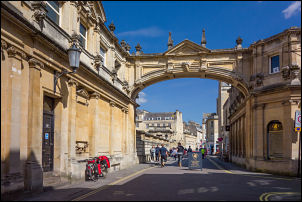
Bath
I rode along the cobbled road at its frontage then descended the
long straight road down in to the centre of Bath. I cycled my way
through the narrow streets which were very busy with tourists and
most of them were wandering in the road without even looking where
they were going. I reach the site of the Roman Baths where I stopped
to take a few photographs. I follow the road for about a mile until
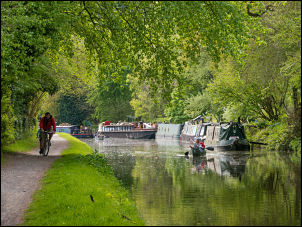
I was able to join the cycle path along the Kennet and Avon canal.
It was smooth tarmac at first but soon became unsurfaced but still
quite easy to ride on.
It was interesting to come to the location of the first plasticine
factory which was built in 1900 and the inventor originally set up
in Bath. Part of my youth was spent making things with plasticine
and I’d never given a thought to where it came from. It was invented
by the artist William Harbutt (1844–1921). He was headmaster of
the Bath School of Art and Design from 1874 to 1877 then later
opened his own Paragon Art Studio. He invented Plasticine around
1897 as a non-drying modelling clay for use by his students. In 1900
he converted a nearby factory in Bathampton to manufacture the
product for commercial sale.
As with the earlier cycle path there were plenty of people out but
the main difference with the canal path is that the route followed
the contour and found its way generally to the east and south. I
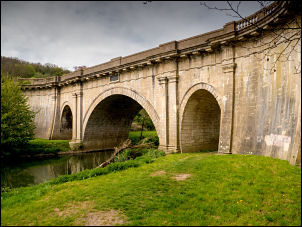
reached a spectacular viaduct at Dundas Wharf where I stopped
briefly to follow a path down to the River Avon to get a better
view. When the aqueduct was first built it only had to take the
canal over the River Avon but later it was altered to take the Great
Western Railway when that was built.
Avoncliff
The next large viaduct was at Avoncliff where I had to leave the
track for a while to descend down and pass underneath then climb up
again to re-join the Kennet and Avon canal on the opposite bank. I
stayed with the canal to Bradford-on-Avon and then left it to join
the road which took me into Trowbridge. Cycling through Trowbridge I
stopped briefly at the Asda Superstore to buy 2, 2litre bottles of
water at 17p each.
Avoncliff River Avon aqueduct
I left the town heading along the road to the south and was quite
surprised how busy it was. I stayed on the main road until I reached
the points where it reached by Clanger wood. I had previously
checked this out on Google Maps and saw a track running through the
woods so I left the main Westbury Road I rode through the car park
and had to negotiate a difficult gate on the path to continue
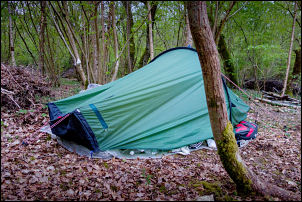
through Into the Woods. I found a clearing on the right which was
ideal to pitch my tent. Late in the evening there was a loud barking
Fox nearby.
 Return to
Whittle Wanderer
Return to
Whittle Wanderer