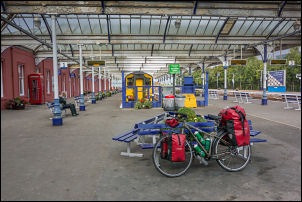
I had a dark cycle ride to Preston Railway Station where I caught
the 06:40am Glasgow train as far as Carlisle. It was about 10mins
late arriving with no explanation. It stopped at platform 3 which
turned out to be where my next train started from. The station was
still covered in scaffolding which was the case when I was last
here. The 08:15 through country stopping train to Glasgow left on
time and made its way slowly through the countryside with two
carriages.
Kilmarnock Railway Station
The bike spaces were 2 banks of 3 where bikes were supposed to
be hung up by the front wheel. I propped mine along the bays and
secured it with chord. Later the ticket inspector said I may have to
hang it up later as one of the stops may have several bikes getting
on. We agreed to leave it for the moment and as it turned out not
many other cyclists used the train so I was OK. I reached Kilmarnock
just before 10am and wheeled my bike outside the station.
Kilmarnock Railway Station
Alexander Morton 1844-1923
The weather was fine but rather windy. I cycled through the town but
had to be extra careful due to inconsiderate motorists. Most of the
buildings were of red sandstone which looked attractive. I soon
reached the A70 road which was too busy to be enjoyable. I continued
east through Galston and on to Darvel. By the road was a stone
carved feature commemorating Alexander Morton 1844-1923 with some
interesting illustrations. The area was involved in the lace weaving
industry. Lace weaving in Darvel.
Memorial
The road then headed out into the countryside and in the distance I
could see an interesting mountain to my left. (Spirit of Scotland)
There was also evidence of a lot of industrial or mining across the
fields to my left. I reached Drumclog and turned right onto the
narrow lane and into a fierce headwind. There was an interesting
looking church here. It was hard work into the wind. In the distance
I could see a line of curved metal sheets across the fields. It’s
hard to describe and when I reached it there was a conveyor belt
under the sheeting which was forming a cover.
Dungavel House
A later check shows it connects parts of Snabe Quarry. Up a short
steep hill I reached the B743 where I crossed over to ride up to
Dungavel House. The sign by the road said Dungavel House IRC.
Originally the house was a hunting lodge for the Dukes of Hamilton
but later became a secure prison and then its current use as a
secure Immigration Detention Centre. I wanted to have a look as this
is where Rudolf Hess was trying to fly to in 1941 on his alleged
peace mission during the WW2.
Dungavel House
He wanted to meet the Duke of Hamilton to get access to Churchill.
He didn’t make it and parachuted out of his plane quite a way off.
There is an imposing security fence around the buildings with a car
park by the entrance. I’d only been there a few seconds when a
security guard approached and asked politely was I OK. I explained
my visit and we were soon chatting about the Duke as he knew about
the Hess story. He didn’t know the Duke was on the team of pilots
who flew over Everest in 1933. He told me the Dukes grave is in the
trees nearby.
Duke of Hamilton's grave
I followed his directions along a path and found the grave which was
a flat stone slab enclosed by a low wall. It was the father of the
Duke I was interested in. I left the area and continued south along
the B743 and into the wind again. My next objective was the village
of Muirkirk and when I reached it I called into a shop to buy a
couple of 2lt bottles of water. I was now on the busy A70 and
decided to camp a few miles ahead at a spot I’ve used before.
Muirkirk
The weather was getting quite gloomy with the feel of rain so
I thought a camp would be sensible ever though it was still early
afternoon. I reached a right turn off to an old railway line that is
now the route of the ‘River Path’ walk. It was still windy and the
tent hadn’t been up long when the rain started. It was very heavy at
first but eased later.
 Return to
Whittle Wanderer
Return to
Whittle Wanderer