|
Last night the weather was clear but I
was greeted by overcast sky and cloud as I looked through the tent
door. I was packed up and away just after 7 am. I wheeled my bike
down the steep path to the road and set off north. The road was also
the Offa’s Dyke Path but I didn’t see any sign of a dyke. The road
was undulating with some long descents but nothing too steep. When
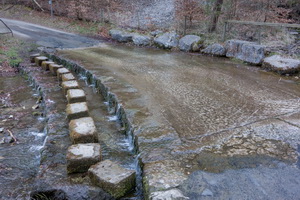
it did get very steep I had to push the bike up to a sharp left hand
bend and a shallow ford. |
|
|
The map gives it the interesting name
of ‘Worlds End’. The road continued steeply upwards and I had to
push the bike quite a way. Eventually I was above the trees and the
gradient eased enough for me to continue my ride. Near the summit a
sign pointed left to a path which was also the continuation of
Offa’s Dyke path. I still didn’t see any sign of a dyke. There was a
long, long descent to the larger road at New Brighton. A mile later
I reached the main A525 which I only had to endure for a short way
before turning off to the right and the B5102 to the A550. Through
Llay I rode along the ‘Straight Mile’ and past Croes Howell Hall
where my cousin used to live. |
|
|
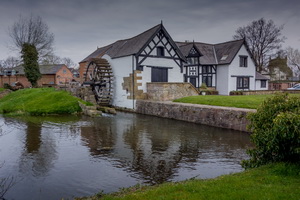
Over the A483 I turned left and
stopped to admire a lovely old building and water wheel at Rossett
Mill. It was first constructed in 1544. In 1710 the millwright
Robert Konrick undertook extensive repairs to the floors and water
wheel. Further extensions took place in the 1820s. The mill was
sketched by Turner in 1795. Through Lavister I came to Pulford Brook
and the boundary where I passed from Wales back in to England. |
|
|
|
|
|
|
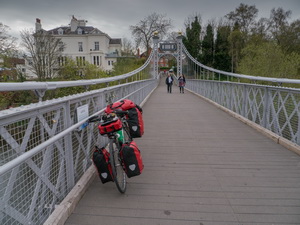
Queens
Park footbridge dated 1923, Chester |
|
|
I followed Rake Lane into Eccleston
and some interesting sandstone cuttings for the road. I turned north
on the Roman Road towards Chester. Along Victoria Crescent I came to
the pedestrian Queens Park footbridge dated 1923. |
|
|
It was opened by the Mayor of Chester
18 Apr 1923. Over the River Dee I entered the park to by-pass a
steep flight of steps then north along the cycle route through the
Zoo area. |
|
|
At Caughall Bridge I was thankful to
join the Shropshire Union canal which I followed for several miles
to the A5117 which I wasn’t looking forward to reaching as I knew it
would be busy. I headed east and left at Thornton-le-Moors to follow
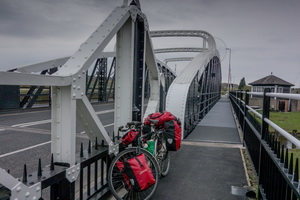
minor lanes. I joined the A56 at Helsby and through Frodsham to
cross the swing bridge. |
|
|
I soon left the main road to follow
the 562 cycle track which winds its way through Halton and Runcorn.
It was quite complicated and I wouldn’t like to have navigated it
without the route on my gps. I enjoyed riding the cycle track along
the Widness – Runcorn bride which was open in 1961. |
|
|
|
Runcorn
- Widnes Bridge opened in 1961 |
|
|
I turned off along the Mersey Road to
get a good view of the bridge then headed north along A568 as quick
as I could to try and catch the 13:20 train at Widnes Railway
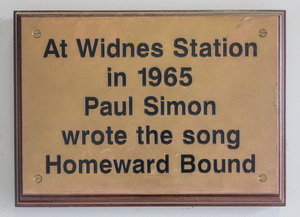
Station. The main reason I wanted to end the ride here was to see
the plaque that says it is the location where Paul Simon was
inspired to write the 1966 hit ‘Homeward Bound’. I made it with a
few minutes to spare. I bought a single ticket to Leyland for £8 and
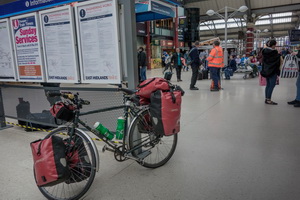
found the plaque inside by the ticket office desk. I took the 13:20
train to Lime Street Station in Liverpool then changed to the
Blackpool train which I took as far as Balshaw Lane, Euxton. It was
just a short ride home. |
|
|
|
|
Homeward
Bound - Paul Simon |
|
|
|
|
Lime
Street Station, Liverpool |
|
|
|
 Return to
Whittle Wanderer
Return to
Whittle Wanderer