Return to
Whittle Wanderer
Return to
Whittle Wanderer|
Langcliffe, Stainforth, Nappa
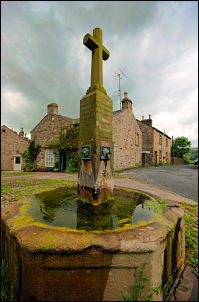
Cross, Rye Loaf Hill, Settle, Yorkshire |
|||
|
SD 8231 6522. |
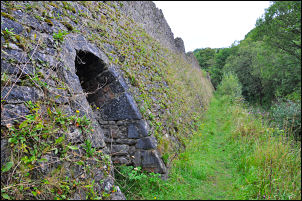 One of the access points into the Hoffmann kiln |
||
|
|
|
||
|
|||
|
I left the quarry and continued north across fields to Stainforth where I headed up Goat Scar lane to Catrigg Force waterfall. |
 The stepping stones at Stainforth. |
||
 Onlooker near the Nappa Cross |
As with the quarries there were too many leaves on the trees to appreciate the waterfall so this will have to be re-done in winter. The bright morning was now heavily overcast and rain threatened as I set off across very wet fields to the Henside Road. I turned right and followed the tarmac for just under 2 miles to Capon Hall. To the right was a path into the field but once over the wall I couldn’t see any sign of it continuing. I headed in the direction where it was supposed to be and eventually came to a track. I soon left it and headed due south over Black Hill until I could see the way ahead. Below was a faint and very wet path to the main path down to Langliffe. |
||
|
When I reached the main path I turned left and headed SE towards Langscar Gate but turned off it before I got there to cross open ground to pick up the path to the restored Nappa Cross. The cross base is probably original and had been lifted up and set on the top of the wall with an old stone lintel stuck in the top to replicate the original cross. I crossed the main Settle to Malham path and headed over the pathless Kirkby Fell. My next objective was the trig point on Rye Loaf Hill which I could see it in the distance. It was a bit of a slog getting there but as I descended the hill there was a stile over the wall and a faint path towards the radio mast on High Greet. The mast and its associated buildings looked very old a deserted. The metal structures were all rusty and vandalised. A good track took me down to the tarmac road where I walked the next mile to Scaleber Force where I climbed through the gate over the wall to have a quick look at the waterfall before continuing down High Hill Lane into Settle. |
 Scaleber Force. |
||
|
|
|
||
|
|
|
||
|
The weather had improved a bit and there was some sunshine. I walked through the narrow streets and searched out the location of the old blacksmith’s to take a photo before continuing to the lane at Castle Hill then on to Langliffe. |
|
||