 Return to
Whittle Wanderer
Return to
Whittle Wanderer|
Grange in Borrowdale, Slate
mines, High Spy, Cat Bells, Brandelhow Park, Cumbria. |
||
|
Drove to Grange in Borrowdale and parked by the Methodist Church. It was a clear calm day when I set off from Grange in Borrowdale. The sky was clear but a haze was preventing any clear views of the hills. I followed the track past Hollows Farm and the deserted campsite. For such a pleasant morning I was surprised that nobody else was about. |
 The first slate mine. |
|
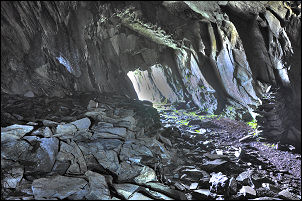 The cavern of the higher mine. |
Following the path up Broadslack Gill I followed it to a point just SW of Castle Crag. I wanted to investigate some slate mines I’d seem a few years ago. I could see them high up on the steep slopes of Lobstone band. There was a faint old track visible so I followed it up to the first mine. After that the track vanished and I had to make my way across loose slate waste until I reached the ruined buildings of the old mine. It was a spectacular location with fantastic views across to Castle Crag and Borrowdale beyond. I ventured inside the large cavern for a look then continued up the mountain. |
|
|
Crossing the loose scree diagonally I was able to reach the line of a stream which soon became easier going. On Robin Fold Edge the main climb was over and I climbed a lesser gradient up to High Spy. The weather was very pleasant with hardly a breath of wind. The haze continued as I walked north along the main path. There were a lot of people about and more as I got closer to Cat Bells. The first thing I noticed was the constant smell of cheep deodorant as I passed each group. Over Maiden Moor I descended to Hause Gate and then over Cat Bells. |
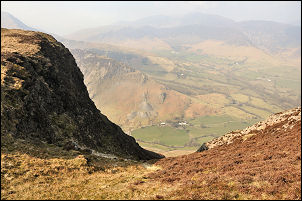 From Maiden Moor. |
|
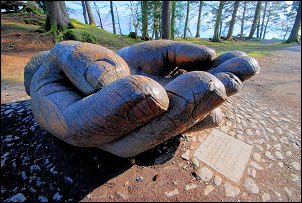 Hand sculpture by Derwentwater |
The summit has a small cairn but is generally very unimpressive but the views were excellent. I didn’t stop because of the crowds. At Skelgill Bank I descended down to the right to the old track above the road. I followed it to the cattle Grid at Hawes End and then into the woods and down to Derwentwater at Kitchen Bay. The main path stays close to the lake but I left it south of Wythsike Bay to head up through the trees as I was looking for a memorial plaque which is supposed to be in the area. |
|
|
I reached the road but still hadn’t found it. It was even further to the north and just behind the wall in the field. The National Trust was created in 1896, largely through the efforts of Canon Rawnsley, vicar of Crosthwaite near Keswick. In 1902 the Brandlehow estate on the west shore of Derwentwater 108 acres of pasture and woodland at the foot of Catbells came on the market. Rawnsley launched an appeal and enough money was raised - the National Trust’s first purchase. The opening ceremony was performed by HRH Princess Louise, daughter of Queen Victoria, on 6 October 1902. After the ceremony, Princess Louise and the three National Trust founders each planted an oak tree. These trees and the commemorative stone are still there. |
 Commemorative stone above Derwentwater |
|
|
|
|
|
|
I returned along the road for a while then descended to Brandlehow Bay and continued along the lake path. At Park Neb I crossed the River Derwent at the footbridge then turned right to follow the river upstream to the road at High Lodore. I left the road at Derwent House to rejoin the river side and noticed another memorial plaque by a tree which commemorated Queen Elizabeth II’s Coronation in 1953. The view of Grange Bridge was quite impressive against the placid river and clear sky. |
||
 Grange Bridge over the River Derwent. |
 Interior of Grange Methodist Church. |
|
