Return to
Whittle Wanderer
Return to
Whittle Wanderer|
Nidderdale, Scar House
Reservoir, Little Whernside, Great Whernside, Angram Reservoir,
Yorkshire. |
|
|
|
|
|
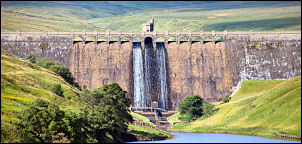
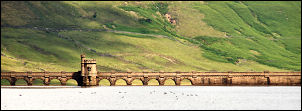
It was a nice sunny drive to Nidderdale via Grassington and Pateley Bridge. I followed the access road to Scar House Reservoir which is owned by Yorkshire Water but is also open to the public to get access to the car park at the first reservoir dam. It’s the first time I’ve visited this valley and I’m glad I did. The sun was still shining when I arrived though cloud was forecast to move in during the morning. Because of that I didn’t hang around and set off as soon as I could. I was the only one on the large car park and was completely on my own as I crossed over the dam of Scar House Reservoir. |
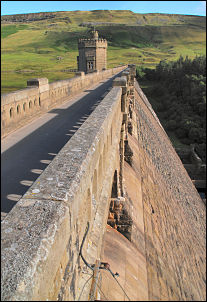 Scar House Reservoir Dam. |
|
|
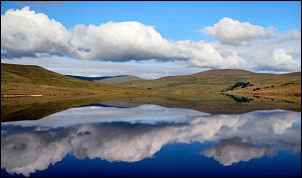
It is quite a magnificent sight and was commissioned in 1936. Looking along the reservoir I had a wonderful view of the distant hills and most of my proposed route. To my right, Little Whernside and further to my left was Great Whernside. After crossing the dam I turned left to follow a rough stone track. |
|
I hadn’t gone too far before the distant view of Angram Reservoir dam appeared. That reservoir is much older, being opened in 1918. Towards the end of the stone track was a ruin on the left called ‘Lodge’. It is shown on the 1850s map so predates the reservoirs. I noticed a tent pitched below, on a flat piece of grass by the reservoir bank. I’m surprised they haven’t been moved on by the authorities, or perhaps they just haven’t been seen yet? The track then turns sharp right and straight up the hillside to the pass summit. |
|
|
|
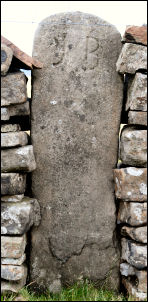
It was a steady climb and the gradient eased a while below the summit. At the gate I turned left to follow the wire fence in a straight line to Little Whernside. The going soon became very wet and I had to cross the fence to try and get away from the black mud. The summit flat area of the mountain was even worse, as I had to make many wide detours to get round the deep boggy swamps. After crossing the saddle at Long Hill Syke Head the ground began to improve a bit and the climb of Great Whernside was much more enjoyable. I came to a gate hole in the stone wall which is were the main path crosses over and descends towards Kettlewell. I kept to the wall and followed up the ridge. Near the summit was a large stone post embedded in the wall with two letters carved in the top. They looked like Y B but the Y is debatable. |
|
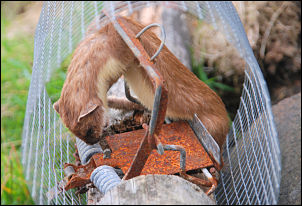
I was now following the same route as last week when I was back-packing. On the north side of the wall was a mechanical trap over a small ditch. What looked like a stoat had been caught in it. It was there last week when I passed. Then I couldn’t see anything because of the wind rain and cloud. |
|
|
|
Now I had good views all round, even if the sun was mostly obscured by clouds. Up ahead was a nice outcrop of grey rocks which made a very nice lunch stop. I continued past the Ordnance Survey trig point and on to Stone Head Crag. |
|
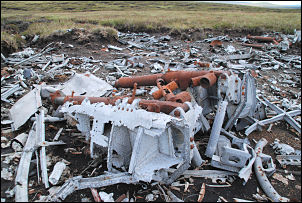
This is where I turned left to follow the wire fence down to the east. Where the fence takes a turn to the SE I decided to strike out across the moor towards Angram reservoir. I hadn’t left he fence far behind when I came to some aircraft wreckage. It was mostly concentrated in a small area and what looked like large pieces of undercarriage were surrounded my many pieces of aluminium which had been in a fire and melted. The site was quite old and was known about as a small wooden cross had been placed by the wreckage, along with a small plastic poppy. |
|
|
|
The going was quite rough as I descend to the reservoir but the lower I got the better the going became. Eventually I came to a sheep track which took me to the wooden footbridge at the southern intake point to Angram Reservoir. I was now on a good service track and it was a pleasant and easy walk all the way back to the car. |
|
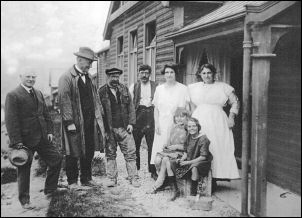
Many wooden bench seats were placed by the track for the weary walker, which includes me, though I didn’t stop until I got back to the car. The area used to be a specially built village for the workers and it was possible to see where all the buildings had been. |
|