Return to Whittle Wander

Kirkland, Cross Fell, Greg's Hut, Cumbria. Wed 10 May 2006

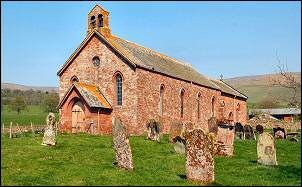
The sky was blue and clear as I approached Kirkland, a few miles to the east of Penrith. Ahead I could see the clear profile of Cross Fell, my main objective of the day. I left my car outside the Church of St Lawrence and leaded off up the track to the NE. it was tarmac for a while and became an un-surfaced road by a small car park. The track climbed steadily up through various areas of old mine or quarry workings.


The old miners tracks.


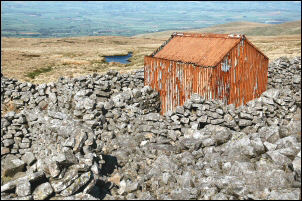
The old bothy.

This is the second time I’ve climbed this track but the first time I’ve been able to see anything. In mist it gets confusing at one point where the track turns north and the faint path continues straight on. There is no way marker to show the point but anyone with a compass should be able to keep in the right direction. The map shows a bothy off to the right. It was lost in the mist on my last visit but this time I could see it and decided to investigate. It was nothing more than a collapsing corrugated iron shed built inside a stone sheepfold. I stopped for a quick coffee in the sunshine before continuing up the fell.

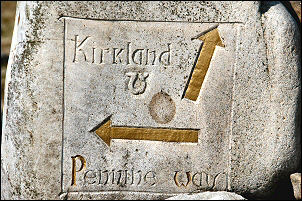
A little over the summit a nice stone way marker shows the branch of to Cross Fell. In mist this would be very useful as even in clear weather the way up is far from obvious. Some of the mini-corries up ahead still had substantial amounts of snow in them. The first part of the way up is wide and wet. Lots of winding detours were needed to keep my feet dry. Just below the summit plateau the map shows a spring called Cross Fell well. It emerges from under a purpose build retaining wall which must have been built a long time ago.


A very nice way marker stone.


One of the summit cairns on Cross fell.

A few more steps and I was on the final easy walk to the summit shelter and trig point. The views were very good and the radar station on Great Dun Fell had the appearance of a rising full moon as it appeared behind the Cross Fell trig point.


The Great Dun Fell radar station appears in the distance.

As I descended to Tees Head I met a couple of walkers coming up, they looked like Pennine Way walkers as they were carrying larger than day rucksacks. I then headed NE along a faint path that took me to an area of old mine workings, spoil heaps, ruined buildings and an adit entrance. The track was now quite substantial and I followed it round Rake End till it met up with the Pennine Way, which was a similar track. It was quite stony as I climbed up through a series of old mine workings and a wonderfully named area called Black Gut. The couple I’d met on Cross Fell appeared again on their way along the Pennine Way. As the gradient eased I rounded a bend to see Greg’s Hut in the distance.


Greg's Hut.


Greg's Hut interior.

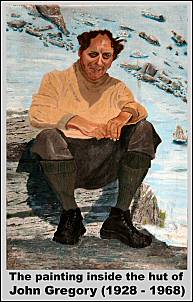
I’d not got this far the last time I was in the area so was looking forward to checking the hut out. I was not disappointed, and had the place to myself as I explored the interior of flagged floors and separate sleeping room. On the wall was large painting of John Gregory (1928 – 1968) to whom the hut is dedicated. The whole place is a credit to the unsung heroes who maintain the building. It was the perfect pace to linger a while and eat my lunch while pondering the surroundings and wonderful views.

John Gregory (1928 - 1968)
The following article is reproduced form the Cybermoor website:
http://www.cybermoor.org/news/old_news_item.asp?intID=233

A welcome shelter from mountain weather.

Greg’s Hut is located at about 2,300 feet on the side of Cross Fell. On a clear day the view is absolutely stunning, and one which would have been familiar to parties of lead miners in the 18th and 19th century. It is astounding that lead was once so precious, and miners so hardy, that Cross Fell was considered a suitable location for mining activities. There is a green road up the first five miles of the fell, leading to the Cashwell Lead Mine. Carry on up a much less well defined path for a further couple of miles, often squelching through bog, and climbing several hundred feet in the process, and you come to Greg’s Hut.

This building was once a lodging-shop for Screeds Mine. All over the area mine owners had provided these very rudimentary buildings, where groups of miners could have shelter, living in damp, dreary and cramped conditions during the working week, only returning to their homes at the weekend. When the industry fell into disuse in the late 19th and early 20th centuries, so did the lodging-shops, and Screed Mine lodging-shop sat, abandoned and isolated, through maybe fifty or more years; through driving snow and keen, deep frost; through mist and endless eroding rain; gradually loosing its slates, its timbers and bits of its walls.

However, in the 1960s a new use was found for Britain’s uplands, and in association with that, for former shepherds’ huts and similar derelict buildings Although mountaineering as a specialist sport had been around for a long time, recreational walking was only just becoming popular. In response to that popularity the Mountain Bothies Association was formed in 1965 to restore these buildings on Britain’s hills for the use of walkers, not only as accommodation but also to give emergency shelter. In 1969 they received permission from the land owners to include the mine lodging-shop on Cross Fell in their programme.

Meanwhile, in the Midlands, the Mercian Mountaineering Club was looking for an opportunity to undertake a project as a memorial to one of its members. John Gregory had died on 6th April 1968 in the Western Alps in Switzerland. His death was as a result of a fall on the icy mountainside while following the High Level Route Saas Fee to Argentiére. It was some time before his friend and climbing partner, Richard Robert Broxap, was able to attract attention and summon help, and an even longer, freezing cold, wait until a rescue helicopter arrived. John Gregory did not die immediately after the fall, and Richard Broxap stayed with him, giving aid and comfort, despite his own injuries.

When the Mercian Mountaineering Club heard about the cottage on Cross Fell they contacted the Mountain Bothies Association and it was agreed its restoration and maintenance would be a memorial to John Gregory.

Now began a Herculean effort. The practical problems of restoring a building that is seven miles off the road, and two miles beyond the end of the nearest track, are formidable.

The two associations worked alternately on the building but the difficulties were compounded by trying to organise things from away, and local help from Cliff Bramwell of Garrigill and the Upper Teesdale/Weardale Fell Rescue Association was of great assistance. Help also arrived in the shape of a group of boys from Wellesley Nautical School at Blythe, who fixed the roof timbers as part of a Duke of Edinburgh’s Award Scheme. Finally the work was completed, and Greg’s Hut was formally opened on May 6th 1972. Since its opening it has been maintained by the Greg’s Hut Association which has members both locally and from the Midlands.

References
Cumbria - Lake District Life. The Dalesman Publishing Company Ltd. 1975
Mountain Bothies Association Journal 95
Alston Moor News Letter Winter 1998/99


Many thanks to Dick Phillips for help with this article and for the photographs

Isabel Lofts


As I was ready to leave another couple descended the track as I climbed upwards. The sky was still clear and blue and the temperature had become even warmer. Over the pass summit a whole new vista of the Lake District mountains appeared. As I descended an older couple were coming up and asked if they were on the right track. I confirmed they were and after a short chat we continued our separate ways. The descent back to Kirkland was easy and pleasant.


St Lawrence, Kirkland.


St Lawrence interior.